

A key to reducing risk is diversification. Yet, many cryptocurrency investors have focused on Bitcoin or Ethereum and missed out on opportunities to diversify their holdings. There are thousands of active cryptocurrencies on exchanges like Binance making it easy to track price targets and predict future growth.
Diversification helps you avoid overexposure to the volatility in any particular investment or asset. Diversified portfolios can help to limit the downside in case any one coin suffers a loss. Diversification can spread market risk as different currencies may react differently to market conditions or financial regulations. For example, if one sector faces regulatory challenges, investments in other areas might not be impacted.
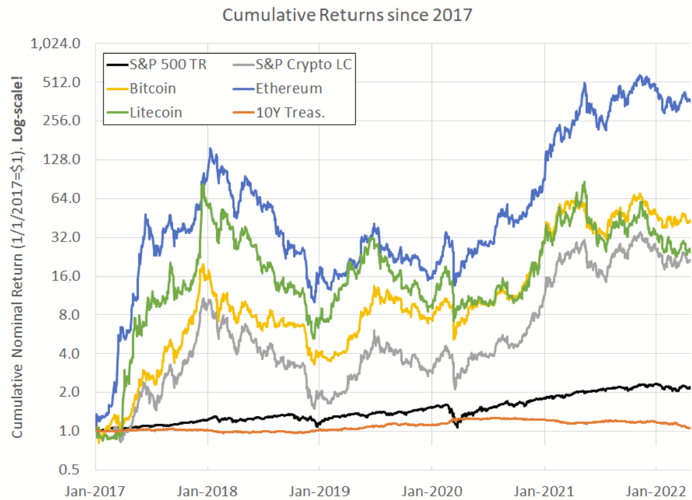
A chart by S&P Global shows how a diversified crypto portfolio would have performed from 2017 to 2022 compared to other investment vehicles.
People are also reading…

Types of Crypto Portfolios
Within a cryptocurrency portfolio, there are plenty of options to diversify your holdings, including:
- Payment cryptocurrencies: Digital currencies designed for everyday transactions as a decentralized alternative to traditional money. These tokens are not regulated by governments which means there’s no central authority guaranteeing their value or preventing fraud. With that said, the fact that these tokens offer fast and secure transactions, lower fees and anonymity makes them incredibly popular with large user bases. These can be very good signs of strong value and future price increases for investors.
- Platform tokens: Native currencies of blockchain platforms used to pay for computational resources and interact with the ecosystem. The Render Network and token is a great example of this. It decentralizes GPU based rendering solutions while using the Render token to pay for animation and motion graphics rendering on the network. According to Binance, Render has a market cap of $2.81 billion and price of $5.43 as of October 16, 2024.
- Security tokens: Digital assets representing ownership in underlying assets like companies or real estate, subject to securities regulations. Security tokens are used in tokenizing ownership in an asset like a car or real estate.
- Utility tokens: Tokens that grant access to specific products or services within a blockchain ecosystem. Unlike security tokens which represent an individual’s ownership in a company or asset, utility tokens provide access to functionality or services within a decentralized network instead of ownership.
- Stablecoins: Cryptocurrencies designed to maintain a stable value by pegging to assets like fiat currencies or commodities.
- Privacy coins: Cryptocurrencies that prioritize anonymity and untraceable transactions through advanced cryptographic techniques. These coins allow users to hide information through unique one-time addresses for each transaction and hiding the transaction amounts.
- Governance tokens: Tokens that give holders voting rights in decentralized organizations or blockchain projects.
- DeFi tokens: Tokens used within decentralized finance applications to enable various financial services without traditional intermediaries.
- Meme coins: Cryptocurrencies often created as jokes or for entertainment, typically with large supply and low individual value.
Tips for Diversification
Investors in traditional financial markets typically diversify their portfolios in various stocks and bonds, targeting a mix of large-cap, mid-cap and small-cap investments; cryptocurrency portfolios can do the same.
Tips for diversification include:
- Investing in different sectors and use cases to help minimize risk
- Considering geographical diversity to spread regulatory and market risk
- Including stablecoins to reduce overall volatility
- Keeping a close eye on your crypto portfolio and rebalance if you fall outside your preferred risk tolerance
- Investing using dollar-cost averaging, investing fixed amount over time to minimize day-to-day volatility
With any investment, there is risk. While some people have seen significant gains from cryptocurrency investments, others have lost money. Before you invest — or diversify — it’s important to do your research. You need to understand the fundamentals behind any investment and stay on top of changing trends and markets. Savvy investors also watch correlations, monitoring how different cryptocurrencies move in relation to each other.
It’s easy to get caught up in the hype about new coins or investments, but diversification is key to optimizing your crypto portfolio.