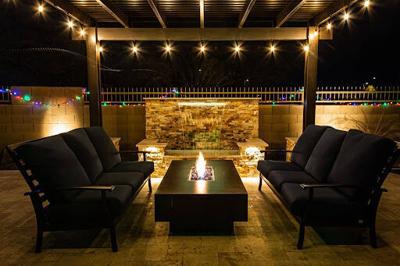


Photo provided by DepositPhotos
Americans are reworking their backyards to be usable across more of the day and calendar, according to recent home-design and consumer research, even as demand for some standalone comfort features has softened. The pattern appears across architect surveys, homeowner spending data, and market forecasts: Money is moving away from one-off amenities and toward permanent setups that make outdoor space usable in the early morning and after dark, as well as during the cooler shoulder months.
Fire features and heated patios lost ground in 2025
The American Institute of Architects' 2025 Home Design Trends Survey found demand softening for several outdoor comfort features. Outdoor fireplaces and fire pits fell from 38% to 25% year over year, and outbuildings dropped from 38% to 21%, according to data reported by Qualified Remodeler. In the AIA's third-quarter 2025 survey, interest in heated exterior space fell from 30% to 12%.
People are also reading…
The decline does not signal homeowners pulling back from outdoor living. The same research found demand moving toward living space that works as a whole, rather than single-purpose amenities added on their own.
Lighting was the top outdoor purchase, at 29%
Homeowner spending points in the same direction. Lighting was the most common product purchase in outdoor upgrades at 29%, ahead of every other category, according to the same survey in the section before. Lighting extends the usable day into the evening, making patios and seating areas functional after sunset.
A fire feature recovers about 56% of its cost
Comfort upgrades that extend evening use continue to hold up at resale. Homeowners recoup roughly 56% of the cost of a fire feature, which averages about $9,000, according to the National Association of Realtors, as reported by This Old House. A fire feature ranked among the top five furniture and decor purchases for 26% of renovating homeowners in 2024, per Houzz.
Fire-pit market projected to hit $13.4 billion by 2033
The market data tracks the behavior. Grand View Research put the global fire-pit market at $8.4 billion in 2025 and projects growth to $13.4 billion by 2033, a compound annual rate of 5.9%. The firm attributed the growth to demand for outdoor space usable across seasons. Outdoor models accounted for 66% of the market, more than 61% of households now spend on backyard comfort features, and outdoor renovation projects have risen 49%.
Permanent structures anchor the trend
Industry data suggests the durable piece of a year-round yard is structural. Lighting and heating both require a defined space to be installed around, and a fixed overhead provides shade during the day and cover after dark while lengthening the usable calendar on either side of summer.
A permanent aluminum pergola serves that function. Unlike a market umbrella or a fold-away canopy, it remains in place through summer sun and winter weather, allowing the features installed beneath it to operate on a longer schedule. The Luxury Pergola markets its aluminum structures as the fixed frame a backyard is organized around rather than a seasonal add-on.
Housing costs are reshaping the backyard
The trend also carries a housing-cost dimension. As new homes trend smaller and trading up grows more expensive, outdoor space becomes a lower-cost way to add usable square footage. Designers and industry experts interviewed by This Old House noted that extending living space outdoors costs far less than purchasing a larger home. That economic backdrop helps explain why spending is concentrating on permanent, daily-use installations rather than seasonal extras.