
It's the last call for farms looking to be recognized at this year's Iowa State Fair.

Eugene Mueller's grandfather, G. J. Mueller, first bought the farm with Mr. Von Burg in 1904. He then bought out Von Burg in 1910. It next went to his son, Harold Mueller, during the Depression in the 1930s. After that, Eugene Mueller bought it. Afterwards it goes to Eugene's son, Mike.
The name of the Century Farm is the M&M Farm, for Mike and Marnie Mueller.
Original price of the farm was between $60-$90 an acre. It was 160 acres originally and is still 160 acres.
Corn and beans, rotated, are grown now. Livestock are beef cattle and pigs. Harold Mueller had corn and beans and oats, along with cattle and hogs.
All of the original equipment has been replaced. Old buildings were torn down 10-12 years ago.
It is just Eugene's son, Mike, running the farm now.
The legacy of the farm is that it is part of the way the family lives.
People are also reading…
Photos: North Iowa's Century and Heritage farms for 2018
Schmidt Family Farms, Inc. - Luverne and Mary Schmidt, Century Farm, Goodell, 1918

William C. Schmidt was the original owner of the Century Farm in 1918. Herman Schmidt inherited from his father, William, then Luverne Schmidt inherited from Herman, his father. The farm became the Schmidt Family Farms, Inc. after incorporation.
Originally, $2,500 was paid for 160 acres. The farm now has 345 acres
Crops are now corn, beans and hay. Livestock is cattle and hogs.
Some 50 years ago crops were corn, beans, oats and hay. Livestock was dairy cattle, beef cattle and hogs.
The oldest piece of equipment on the farm is a 1948 "B" John Deere tractor. It is occasionally used as a yard tractor.
Over the years building design and use has gone through a complete change. Equipment and tools have gone from horse farming to tractors with GPS and computers.
Pricing of products produced is now determined on a global basis. Items grown used to be consumed locally; now production is sold and shipped hundreds even thousands of miles away.
Members of the third, fourth and fifth generations of Schmidts are now farming the land.
Now the sixth generation living on the Century Farm is the legacy. The Schmidts plan to keep the farm in the family for many more years.
Shirley and Yvonne Stevens, Rick Stevens, Century Farm, Clarion, 1918

The Stevens Family Farm was purchased March 1, 1918, by Charles and Harriet Stevens, grandparents of Shirley Stevens and great grandparents of Rick Stevens. Charles Stevens died the following year in 1919. Harriet and four young sons were left to carry on with the farm.
The Century Farm was purchased by her son Leslie and wife Lila Stevens after Harriet's death in 1951. Shirley and Yvonne Stevens and son Rick Stevens purchased the farm in 2003 after the death of Lila Stevens, who was the aunt and great aunt of Shirley and Rick.
The original cost of the farm was $12,500 for 160 acres. The farm is still the original 160 acres. Crops are corn and soybeans. Originally crops would have been corn, hay and oats, along with livestock.
The original barn is still on the farm and is used for storage. There is a small pasture that is used for 8-10 cattle during spring to fall.
The farm produces corn and soybeans only. The crops have progressed to Roundup Ready products.
Rick Stevens now farms the farm.
The plan is to keep the farm in the family as long as possible. There are four other children in the family. all of whom appreciate the value of the farm and who are very proud to have been a part of the Century Farm presentation at the Iowa State Fair.
Donald Fluhrer, Heritage Farm & Century Farm, Charles City, 1868

When Donald Fluhrer applied to be named a Heritage Farm, they were given a Century Farm designation as well.
Donald's great grandfather Jacob Fluhrer settled on the farm in 1868. Jacob's son Art Fluhrer next had the farm and Art's son Walter Fluhrer took over after that.
Pat and Donald traded for it four or five years ago with a farm next door.
Original price for the farm was $10 an acre.
The farm was originally 160 acres, a quarter section, and it is still 160 acres. The same acres comprise both the Century Farm and the Heritage Farm.
Now rented out to another relative, the farm is one-half corn and one-half soybeans, rotated.
Crops 50 years ago were hay, oats, corn, soybeans and pasture. Walter had cattle, hogs and chickens.
No original equipment is on the farm any more. It was sold five to six years ago.
Years ago, harvested corn yielded 70-80 bushels of corn per acre. Yield is now 200 bushels per acre. A good crop.
For Donald, the legacy of the farm is that it is the home where his great grandfather lived and he wants to keep it in the family. His four daughters will inherit it.
Gayle Melcher - Additional Titleholders: Darcy Mullenbach, Judith Coyne, Heritage Farm, Charles City, 1868

Known simply as the Melcher Family Farm, this Heritage Farm was originally owned by George and Mary Melcher in 1868. The Melchers immigrated from Germany. Lewis and Carolyn Melcher bought the farm in 1885. A veteran of the Civil War, Lewis joined the Wisconsin Volunteers when he was just 16. and was stationed in Mobile, Alabama. He was awarded Grand Army of the Republic medals.
Lewis sold the farm to his son, Charles Oscar, who built the present building site in 1910. His wife, Amelia, died in 1958. In 1903 the buildings were by the road. Charles Oscar's son, Oscar Lloyd Melcher and his wife, Phyllis, bought the farm from his siblings in 1958 to settle Amelia's estate. He paid $350 an acre. A World War II veteran, Oscar Lloyd Melcher served with the Army in the Pacific, and was involved in liberating the Philippines. He was born on the farm in 1918 and his 3 1/2 years in the war were the only time he was away from the farm. He was Gayle Melcher's father. Oscar Lloyd died in 1991, and Phyllis took over the farm until 2009. Gayle and his sisters Darcy Mullenbach and Judy Coyne and his brother Lloyd inherited the farm in 2009. Lloyd farmed the land and died in 2015.
Originally, the farm was 160 acres and it is 160 acres today. It is the northwest quarter of Section 20 in St. Charles Township. The farm was rented out in 2010 to Grant Greenzweig, a neighbor, who farms the land and participates in the Beginning Iowa Farmer Program, a state program from the Iowa Department of Agriculture that helps young people get started.
Today, corn and soybeans are rotated, and there is no livestock. Gayle's father had corn, hay and oats and raised pigs farrow to finish. He also fed out cattle and had chickens and sheep.
Production has changed over the years, and the number of bushels per acre has risen dramatically. Gayle's father had the last team of horses in 1953. Now tractors drive themselves. The farm is tiled, and waterways against soil erosion save the soil. No till and minimum till are practiced. Equipment is GPS now and handles 48 rows.
The farm is southwest of Charles City and over the years all the Melcher children went to Schoolhouse No. 8, a short mile away.
A dozen family members attended the Heritage Farms Awards Ceremony. Gayle organized a reunion for the day after the awards ceremony. There were 90 Melchers and neighbors at the farm for the reunion. The West St. Charles Church was part of the neighborhood.
New to Facebook, Gayle used Facebook, letters, email and the phone to reach the family. The reunion can be found on Facebook at 150th Melcher Family Reunion. Register to be a member and then Gayle can let you on.
Family members at the reunion came from six states and everybody brought family memorabilia, including the GAR medals. Cousin Jerry Irons trailered the John Deere A tractor of their grandfather's from Clarence. An uncle, Gayle's father and cousins had all driven the tractor, so Gayle got to drive it again.
The legacy of the farm is that it is the heritage of the family. Gayle's goal is that the next generations keep the farm in the family. Everybody can come home and actually be a part of history.
Ronald and Esther (Groe) Halvorson, Heritage Farm. 1858

The farm is known as The Groe Farm.
Tosten Groe and his wife homesteaded the Heritage Farm for five or six years, then the government gave it to them. Tosten was Esther Halvorson's great grandfather. Tosten had three sons. Esther's grandfather A. T. Groe then bought the farm. Alfred Groe, Esther's father, bought parts of the farm in 1932. Ronald and Esther bought the farm in the 1970s.
Original acres were 120. A few years later Tosten bought 40 more acres. Now all parts are touching each other and were bought at different times, making up 390 acres.
Corn and beans are grown now. The farm diversified over the years, from dairy cows, hogs, mules and horses to other cattle. Esther's folks also had dairy cows and other cattle.
Their son Lee Halvorson is farming the land now. Ronald and Esther Halvorson are retired and maintain ownership.
Esther said their four kids say there was no better place to grow up. They learned about life and death, responsibility, how to work and what farming is all about. A daughter is now a small animal veterinarian, which came from the farm. A corporation has updated meetings annually about outlook and progress and the kids are very open to learning what goes on and where we stand.
All four kids were at the Century and Heritage Farms awards ceremony, which delighted their parents.
Carolyn K. Welden, Century Farm, Kanawha, 1892

Gerhard Prull and his wife, Marie, were originally on the Century Farm in 1892. Gerhard was Carolyn Welden's great grandfather. In 1902 her grandfather Charley Prull and his wife, Fannie, started on the farm. Charley was Carolyn's grandfather. Carolyn's father inherited the farm in 1942. Her parents were also Gerhard and Marie. Carolyn and her sister, Janice, inherited the farm in 2001 and owned it together. In 2004, Carolyn and her husband, John Welden, bought out her sister. John died in 2011 and Carolyn became the full owner.
There are no original buildings left, but a grove is still standing.
The original farmstead was 80 acres and more was added later. The farm is now 240 acres and is in corn and beans, rotated.
Carolyn's father made a replica of the farm and it is now on exhibit at the Hancock County Farm Museum at the Fairgrounds.
Grown and raised 50 years ago were corn, oats and alfalfa. Livestock was dairy cattle, pigs, chickens and duck. Beef cattle were added later. There is more grain per acre now.
No original equipment is left. Some of the equipment Carolyn's father had is also at the Museum.
The farm was self-sustaining when Carolyn was growing up: gardens, chickens and livestock was butchered.
Carolyn's children had a rock from the farm inscribed with Prull Family Farm. The rock was placed by the lane that would have led to the buildings. The Century Farm plaque will go on it. The rock was brought up from the grove.
The farm is rented by Dallas Johnson and he and his father both farm it.
Since she grew up there, the farm means a lot to Carolyn. Her children were babies when her parents moved to town, and she doesn't know what they will want to do when the farm is passed on to them.
Sara A. Noss, Century Farm, Dougherty, 1900

The Century Farm is known as the Noss Family Farm. It is two miles east of Dougherty. Carl Noss bought it in 1900 for $45 an acre. He was the grandfather of Robert (Bob) F. Noss, Sara's husband. John Carl Noss, Bob's dad, had the farm next. Bob and Sara bought it from John Carl in the 1960s. John Carl was still on the farm and died there. Bob died in 2015 and Sara has had the farm the last three years. Sara reports she was a city girl at first. She's now owner and manager.
Originally there were 120 acres. The farm now has 320 acres.
There were 20 family members at the awards ceremony, including Bob's two brothers and most of the children.
Bob and Sara had five children. One son farms the land and alternates corn and beans. There are a few acres of hay and a few head of cows. There used to be hogs. Bob's father, John Carl, had corn and beans and hay, with horses at first. Grain is sold to the elevator.
A few pieces of the older equipment are left, but not the big equipment. Unlike the older equipment, now the equipment has air conditioning.
Bob's father and three boys farmed the land until the first two married and moved away, then it was just Bob and his father, John Carl, farming together.
All of Bob and Sara's five children want to keep the Century Farm as the family farm. It means a lot to have a farm that's been in the family so long.
Keith Bilyeu - Additional Titleholders: Adeila Bilyeu, Steve Bilyeu, Jeffrey Bilyeu, Joel Bilyeu, Angela Bennett, Century Farm, Woden, 1918

The name of the Century Farm is The Bilyeu Farm.
Josiah and Karen Bilyeu were the original owners in July of 1918. Four sons were in the service at the same time. Roy was too young and farmed with his father. Josiah died at age 57 and Karen continued to farm with Roy. With help from her sons, Karen kept the farm together during the depression. From 1950 to 1959, Roy and his brother Merle farmed together. Merle was Keith's father, and he bought the farm from his siblings, along with his wife, Adeila, in June of 1961. Roy and his wife, Norma, started a business after 1959 and moved to Mason City. Merle retired in 1990 and started renting out the farm to Jim Steffen and Matthew Swingen. They cash rent and farm the land. Keith is also retired and has kept up the rental agreement. Adeila is 90 and in a nursing home in Story City.
The first mortgage on the Bilyeu farm in 1918 was $15,768 or $146 per acre. In 1961, Merle bought the farm for $275 per acre.
Acres were 108 at first. Now there are 240 acres. The Conservation Reserve Program acres are used for pheasant hunting.
Corn and beans are rotated today. Josiah and Karen had milk cows, hogs, chickens, ducks, geese and sheep. Oats, straw and Timothy hay were for the horses, corn for the hogs, and alfalfa for the milk cows.
A lot of horse-drawn equipment was sold or cut up for metal. A manure spreader is from the late 1940s or early 1950s. The family had no running water until Keith was 16. Electricity came in 1940.
There are no buildings on the farm, but some foundations are left: for the hog house, the hen house and the house.
Over the years, production has changed a lot. When Keith graduated from high school in 1967, it took a month to harvest. Now corn is out in one day and soybeans are out the next day. There was an 8-row planter when Keith went to college.
The hope is to keep the farm in the family. Keith and his older brother are the most connected and he says his kids don't have farming in their blood.
Legacy of the farm was celebrated for four days by 100 family members related to Josiah. The celebration started the day after the Awards Ceremony.
The reunion was organized by Steve Bilyeu of San Antonio, Texas, Beth Bilyeu of Clear Lake, and Keith. Family came from California, Utah, Texas and Iowa.
They went to the Iowa State Fair, a picnic in Forest City, the Grant Township Cemetery close to the Century Farm and then to the Century Farm. While the adults went to reminisce in the Woden Community Center on Saturday, the kids enjoyed themselves at the City Park, getting used to the merry-go-round. The Forest City Lodge was rented for more memories and a brunch was Sunday morning.
Larry and Barb Bissen, Century Farm, Stacyville, 1918

Larry and Barb Bissen, Century Farm, Stacyville, 1918
Marks Family Farms LLC - Additional Titleholders: Barbara Marks, Linda Rasmussen, Diane Rench, Janice Trent, Michelle Wilkinson, Century Farm, Clarion, 1883
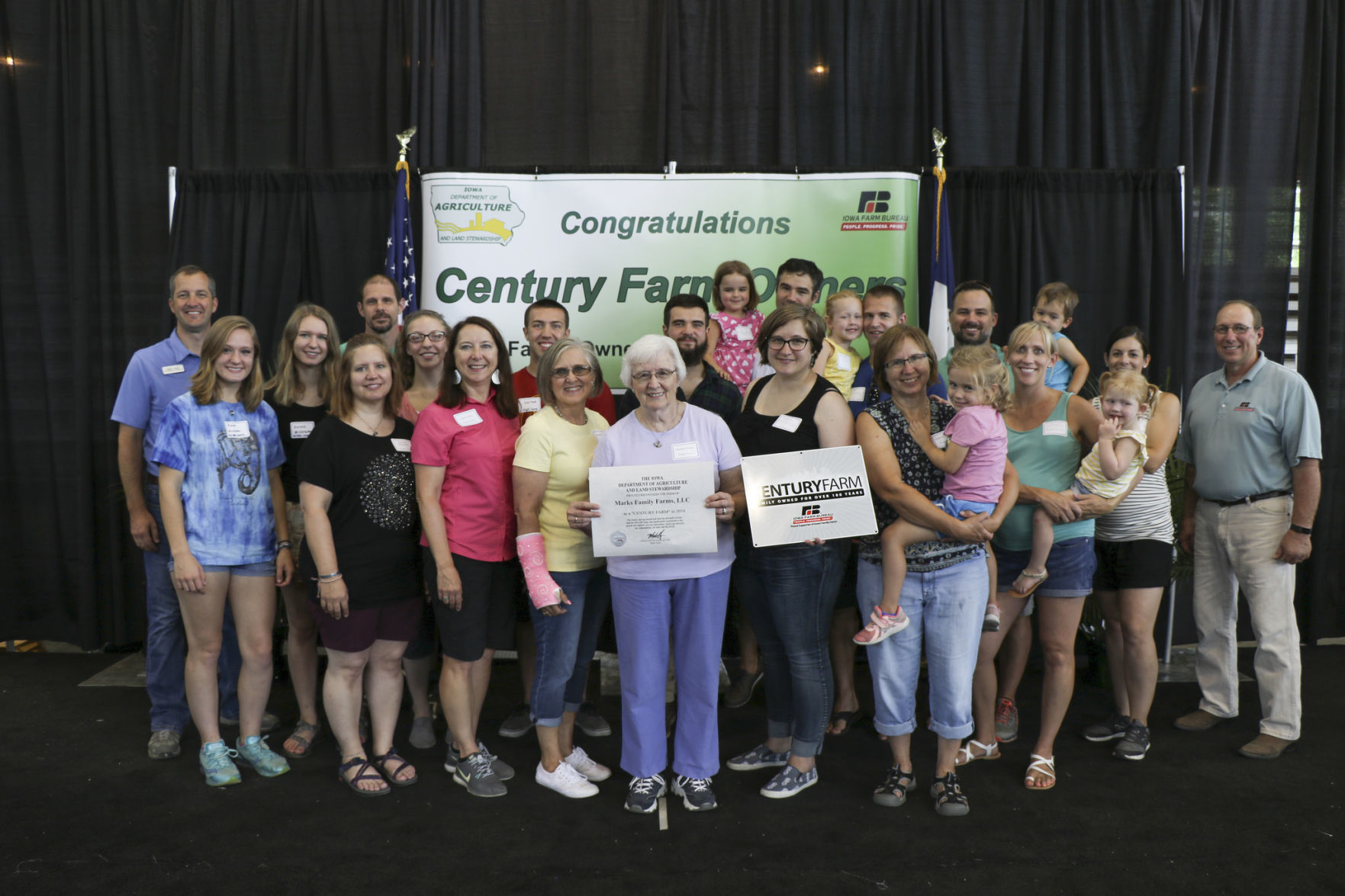
The original owner of the Century Farm, in 1883, was Lyman Burdick. He bought 160 acres for each of his five children. Daughter Lula Burdick Esget inherited. Lula left it to her daughter, Elizabeth Esget Marks, who left it to her son, Richard. The farm is the only 160 left in the family. It was Lula's. Richard and Barbara Marks put the 160 acres into the LLC. Their four daughters are additional titleholders.
Corn and beans are grown now, rotated. No livestock. Corn, beans and hay were grown in the past. Just one person and the family farmed the land.
There is no original equipment and there are no buildings. The farm is bare land.
The farm is rented to Duane Schnittjer, who farms by himself and does his own marketing. It is done as cash rent.
The legacy of the farm, said Barbara. is that it is just special to us because it has been in the family so long. Richard and Barbara want to keep the farm in the family as another piece of family history. Family members from Maryland to California attended the awards ceremony, and the children did "fun things."
Nathan Poncin - Additional Titleholders: Ronald Poncin, David Poncin, Kevin Poncin, Natalie Poncin, Century Farm, Galt, 1889

First owner in the family of the Century Farm was Fird Poncin, Nate's grandfather. Then to Nate's parents, Charles and Theresa Poncin. Theresa Poncin was next. In 1965, Nathan Poncin became the owner.
There were 300 acres originally and there are still 300 acres now.
Corn and beans are rotated now. Used to feed cattle and hogs. Earlier, 50 years ago, cows, pigs and chickens were raised. Crops were mainly corn and oats.
A 1976 tractor is the oldest piece of equipment on the farm and is still in use.
Over the years, "everything's changed," said Nate.
Nate is 86 and still farms.
He wants the Century Farm to stay in the family. His sons will take over.
Evelyn Rademacher, Century Farm, Charles City, 1915

John Rademacher was the first owner of The Rademacher Farm in 1915. After him came John and Johanna Rademacher, Ed and Marie Rademacher, and Eldon and Evelyn Rademacher.
Originally the Century Farm was 160 acres. It is now 1970 acres.
Corn is grown today. Grown 50 years ago were oats, alfalfa, soybeans and corn. Livestock was cattle, chickens and hogs.
The oldest piece of equipment on the farm is a Farmall 460 tractor, which is still in use.
The family has maintained three full-time workers and one part-time. Equipment went from 40HP tractors to 600HP and a 4-row planter went up to a 36-row planter now. Chemicals were not sprayed until about 50 years ago. Cultivating corn stopped in the 1990's. A 2-row picker was used 50 years ago and now corn is shelled with a 12-row cornhead. Corn cribs have been replaced with 400,000-plus shell corn bin storage.
Operation of the farm has been maintained in the family and is now on the fifth generation. Primary operators are Richard Rademacher and Eric Rottinghaus.
The legacy would be to continue the farm into the sixth generation. The farm is the family's whole life and they love working the land and watching hard work pay off when the crops grow. There is also enjoyment watching the kids' excitement riding in the equipment and playing in the fields. The perks of being your own boss are pretty nice, too!
Clint and Justina Hamilton, Century Farm, Hampton, 1913

The farm name has been put under the current owners, Clint and Justina Hamilton.
Sen Jensen was the original owner in 1913. He was Clint's great grandfather. Next on the farm in 1962 was John Stadtlander, Clint's grandfather. Clint and Justina bought the Century Farm in 1996. They took over after John's wife, Esther, died earlier that year.
Original price for the farm was $79.37 per acre.
The farm was originally 126 acres. Clint and Justina have 7 acres in an acreage. Clint's mother, Laura Hamilton, and uncle, Arvin Stadtlander, still run the 119 acre farm ground part. Steve Simons rents and farms the land.
On farm ground corn or soybeans are grown. Justina raises beef cattle.
Esther had a very big garden, and pigs and chickens were raised. As for the children, Arvin's pet pig would pin Laura in the barn while she was gathering eggs.
A Farmall 8 tractor has been kept and was readied for parades in Coulter. Clint will be on tractor rides when he has time.
Justina says she's a city kid and has lived there since 1996 on the acreage. They don't do chickens or hogs. Production has simplified over the years, and there's a grocery store nearby that meets their needs. Basically, they're self sufficient, she says. Justina wants to turn the farm into production and raise cattle. So far it is in farm use.
The original barn burned down in an accident in 1997. The chicken house is now a small shop and the corn crib is now a big shop. The hog house has been turned into a barn. Cattle are raised there. Clint built the original house into a Victorian.
The Century Farm means security to the family. It's where everything started and it's home. When daughters talk about coming home, they mean the farm.
Melvin Koenigsberg, Century Farm, Sheffield, 1918

The Century Farm is in Melvin Koenigsberg's name, and is known as The Koenigsberg Farm. The original owner in 1918 was Melvin's father, Ole Koenigsberg. Melvin then rented the farm and bought it in 1985. Prior to 1918, the lot was bought from the government in 1854.
The original farm was $400 an acre. There was an $8,000 mortgage on 80 acres and a $4,000 mortgage on 40 acres. The 40 acres have changed hands often. There are 120 acres now. The 80 acres are on one side of the road and the 40 acres on the other side of the road.
Corn and beans are rotated now. Corn, oats, hay and pasture plus cows, chickens, horses and pigs were on the farm 50 years ago. A 1953 tractor is still in use.
Melvin is not farming now and the farm is rented out. The renter goes through a nearby coop.
From his father, Melvin is keeping up most of the buildings. The 40-by-80 barn is original and used to hold 10 cows and eight horses. Ole could ride two of the horses. He also used mules.
The first tractor was a 1939 B John Deere. It is still around but Melvin doesn't own it.
Ole moved to Sheffield in 1948 and two older brothers rented from him. Melvin is the last one of Ole's sons.
The Century Farm was well-tiled on the 1990s, and it is good ground. It was a full 160 acres.
The renter gets tremendous crops now - 200-225 bushels on corn now. Seed and fertilizer prices have gone way up. Melvin quit farming 11 years ago.
The north half of the house is original and the basement is stone. Melvin built onto the south side and extended the kitchen wall between the dining room and the living room.
Melvin remembers the steamers on the Iowa Falls to Mason City railroad when it was the Rock Island Rocker. It is now the Union Pacific and he watched it all.
The legacy of the farm is its meaning to the family. Melvin has a daughter and son and two grandsons.
Loren Pannkuk, Century Farm, Titonka, 1902

John Pannkuk was the original owner of this 2018 Century Farm in 1902. He was Loren Pannkuk's grandfather. Next were Loren's parents, Irvin and Marjorie Pannkuk. Marjorie is in a Care Center and the children rented it from her then owned it together for a year. Loren bought it from his siblings in December last year.
The original price for the farm was $100 per acre. It was 80 acres in 1902 and is now 75 acres.
Crops now are corn and soybeans, rotated. The crops go to a local Coop. Around 1970, crops were corn and oats. Irvin Pannkuk, Loren's father, had a lot of livestock, including cows, chickens and hogs.
There is no original equipment on the farm.
Loren Pannkuk is retired and the farm is rented out. It has always been a family farm, and he wants to keep it in the family, which consists of children and grandchildren.
Myra (Severson) Harris, Century Farm, Northwood, 1914

Clarence and Julia Severson were the original owners of the Century Farm in 1914. In 1960, Leighton Severson became the owner. He was the father of Myra (Severson) Harris, who bought the farm at an auction in July 2003. It is the last piece of ground that was homesteaded. Her mother is in a retirement home. Leighton Severson was an only son, involved in farming, so he didn't go into the army in World War II.
Myra also has the farm next to the Century Farm, which is the south part of the section.
Original cost of the farm was $8,100, or $100 an acre. The original acres were 80, and the farm is still 80 acres.
Today a portion - eight acres - is in wet land, a pond which will never be changed. A Monarch habitat is 11 acres in the Conservation Reserve Program. The rest is in corn and beans. The CRP acres have to be burned every 10 or 15 years to get rid of the trees that shouldn't be growing there, Then it grows back as prairie. The seeds in the ground don't burn.
Crops 50 years ago were hay, corn and beans. There was no CRP then.
No original equipment is still on the 80 acres of the Century Farm.
Yield has changed considerably over the years, also expenses. A yield of 50 - 60 bushels per acre was good 50 years ago. Now it is 75-200 per acre. Weed control, seed and fertilizer have changed considerably during the last 50 years. Clarence Severson farmed with horses.
Her youngest son does the farming and his own marketing, Myra does the book work and he does the labor. There is one full-time hired man. A grandson who is a senior in high school has been helping. Myra has four children.
It is knowing that something was kept in the family is the legacy. Just knowing that something has been kept in the family. Some are really happy that it has stayed in the family. Myra hopes it is maintained and kept in the family.
Eugene Mueller, Century Farm, Manly, 1910
Eugene Mueller's grandfather, G. J. Mueller, first bought the farm with Mr. Von Burg in 1904. He then bought out Von Burg in 1910. It next went to his son, Harold Mueller, during the Depression in the 1930s. After that, Eugene Mueller bought it. Afterwards it goes to Eugene's son, Mike.
The name of the Century Farm is the M&M Farm, for Mike and Marnie Mueller.
Original price of the farm was between $60-$90 an acre. It was 160 acres originally and is still 160 acres.
Corn and beans, rotated, are grown now. Livestock are beef cattle and pigs. Harold Mueller had corn and beans and oats, along with cattle and hogs.
All of the original equipment has been replaced. Old buildings were torn down 10-12 years ago.
It is just Eugene's son, Mike, running the farm now.
The legacy of the farm is that it is part of the way the family lives.
Douglas Penning - Additional Titleholders: Barbara Donkersloot, Carolyn Edgar, Century Farm, Buffalo Center, 1918

There is no particular name for this 2018 Century Farm. It is simply referred to as Penning Farms.
The farm was originally owned by Bill Penning, Douglas Penning's grandfather, in 1918. In 1963, it went to Clarence Penning, Douglas's father, and then Douglas Penning inherited the farm in 1998.
Originally the farm had 160 acres. It is now 240 acres, but just the 160 acres are the Century Farm.
Now crops are corn and soybeans, rotated. There are no livestock.
Corn and beans and alfalfa were grown 50 years ago. Livestock included cows, hogs and chickens.
Original equipment on the farm is a cultivator. It isn't used now, but it could be.
Production hasn't really changed from grandfather to father to Douglas Penning. Grain goes to the elevator and some used to be fed to livestock.
Douglas is farming the land and says "a Century Farm is quite an accomplishment to me," as the legacy of the farm.
Patricia Hockenson, Century Farm, Floyd, 1913

The Exline-Hockenson Farm was first in the family with David Exline in 1913. His son, Everett Exline, was the next owner. Patricia Hockenson inherited the farm from Everett Exline, her father.
Originally, this Century Farm was 180 acres. It is now 72 acres, "with a big lawn," Patricia says.
Corn and beans are rotated now. Originally there were corn and beans, hay and oats, with milk cows and chickens. Plus cats, horses and dogs.
The oldest piece of equipment is a horse-drawn hay rack, which is not in use. There is also a corn sheller which is not in use.
Everett Exline farmed with horses and Patricia got out of school to help her father,
Patricia notes she and her siblings "were workers." They were out in the field, which was a hard life. Now there are big tractors with air conditioners. "I think us kids had more fun," she says. She wouldn't live anywhere else.
The farm is rented out and Patricia is the manager. The farm means a lot to the family. There are her children and nieces and nephews. "No way we could let it go," Patricia says.
"It's just wonderful, and I thank the Lord every day for it." Memories of her parents again surfaced when Patricia first moved in. "I felt like they were still here."
Laura S. Weers, Century Farm, Mason City, 1890

This Century Farm was acquired by Weert E. Weers in 1890. It next went to Bardelt Weers, grandfather of Laura S. Weers. Elmer B. Weers, Laura's father, next farmed the land. He died in 2002 and Laura took over the farm.
Originally the farm had 120 acres. It now has 239 acres. Elmer bought 80 acres and Laura bought 40, with one acre away for a road.
Known as The Weers Farm, the land is now rented out and corn and beans are alternated. It is now in beans. It has always been in corn and beans, but there were oats years ago. There were never more than 40 acres of oats. Cattle were gone 50 years ago and hogs and chickens were gone 46 years ago.
The oldest piece of equipment, an Emerson plow pulled by horses, was donated to the Kinney Pioneer Museum.
The last combine Elmer worked covered eight rows. Laura watched corn dryers and unloaded grain wagons.
In 1933, Laura's grandfather had to quit planting corn May 10 because of a snow storm.
Grain is marketed at the Burchinal and Portland Coops. One thousand bushels fills a semi.
Laura said she is honoring her parents, with whom she had a wonderful relationship, by keeping up the farm. Laura has always lived on the farm and wouldn't want to live any place else.
Helen Mueller, Century Farm, Northwood, 1882

Nels Turvold was the original owner of the Century Farm in 1882. It has been in the family 136 years. Next was Olaf Halvorson, the grandfather of Helen's son Dean A. Mueller. Olaf Halvorson was followed by a combination of Helen Mueller and two brothers, Ariegh Halvorson and Richard Halvorson. Helen bought Richard out and Ariegh died eight to nine years ago, said Dean Mueller, leaving Helen the total owner. The farm was 80 acres originally. It is now 200 acres. Dean Mueller bought 40 acres and an acreage. The original buildings are all gone.
Corn and beans are grown now. with Dean having a pollinator mix in the Conservation Reserve Program and Helen having native grasses in the CRP.
Corn and beans and pasture were grown 50 years ago and beef cattle were raised. Old aerials of the farm show hog houses. Just family farmed the land, Dean's grandfather and uncle. There have been a lot of different marketing strategies over the years.
Equipment still on the farm are corn shellers with hookups to a tractor. There is a piece of a horse-drawn 2-row cultivator and a 3-bottom plow.
The legacy of the farm is that the family has grown up with it and the farm is part of the way the family lives, with 3-4 generations attached to it.